

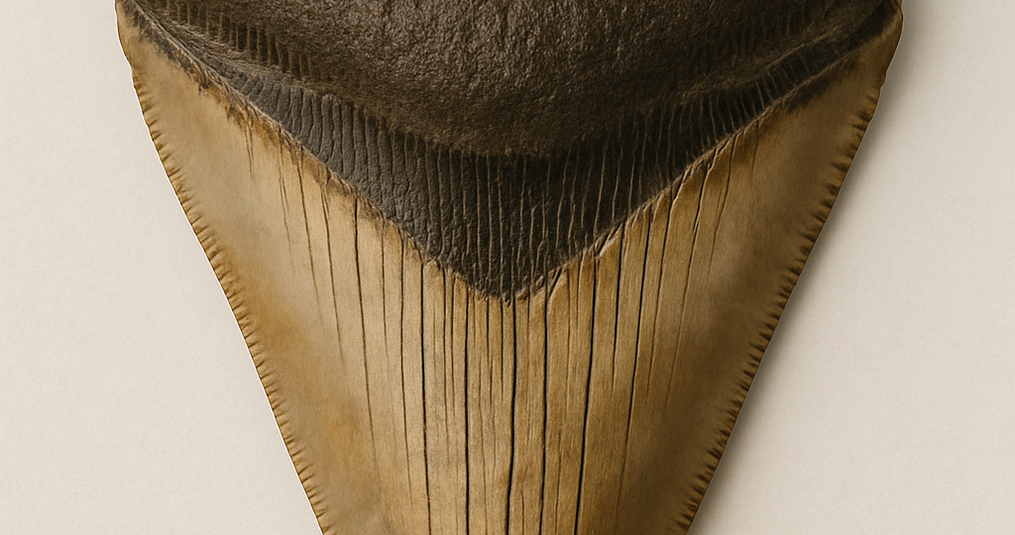
Owning a Megalodon tooth is something special. This not only because it is a tangible reminder of one of the largest predators that ever lived here. This means that each tooth is therefore definitely millions of years old, it is a piece of history, fossilised and also preserved by time.
So it doesn't matter if you bought your first Megalodon tooth, or have already built up a small collection. Proper maintenance and also proper preservation are really extremely important to keep this fossil treasure in top condition.
In this blog, we go into detail on everything you need to know about preserving, cleaning, protecting and also exhibiting a Megalodon tooth. This guide is really for everyone, from the enthusiastic collector to the curious newcomer, who wants to get more out of his or her fossil.
What exactly is a Megalodon tooth?
Of course, before we really get into the content of the blog, it is good to briefly touch on what a Megalodon tooth actually is.
A Megalodon, also known as the Otodus megalodon, was a truly gigantic shark, which lived around 3.6 to 23 million years ago. The Megalodon's name simply means "big tooth", this of course for good reason: the teeth of this animal could easily reach 18 centimetres in length. The most commonly found teeth have a length of between 7 and 13 centimetres. The Megalodon, like all current sharks, was known to constantly lose teeth in their lifetime. This just like the modern shark, which is why millions of fossil teeth are found scattered all over the world.
So we know that a Megalodon tooth is a fossil. This is the only hard part of the animal that is actually preserved in rock and also sediment. The tooth consists mainly of mineralised dentin and enamel. It can also vary in colour, texture and also quality.
Why good maintenance is important
An awful lot of people absolutely do not realise that a fossil, this despite its incredibly massive past, can still be incredibly vulnerable to outside influences. The idea many people have is that something that has been scuttling across the sea beds for millions of years can take a beating. However, nothing could be further from the truth, although that a Megalodon tooth, something made of natural materials and preserved under geological conditions for millions of years, can be affected by modern environmental factors if not properly cared for.
Some of the most common threats are:
- Moisture and temperature fluctuations
Fossils absolutely do not like extremes. Fluctuations in temperature and also humidity can continuously cause expansion and also contraction in the natural material, resulting in hairline cracks or even crumbling. Teeth composed (in part) of porous dentin react especially strongly to moisture changes. - Oxygen and humidity
Far too much oxygen combined with high humidity, in turn, could lead to oxidation or mould growth. This is something that mainly happens to fossils stored in worse ventilated areas. Think about basements or sheds. It is something you will probably not always notice right away, yet your tooth may discolour or even lose its shine over time. - Improper cleaning methods
It can look somewhat easy, cleaning a fossil. Yet with the wrong approach, you can do far more damage than good. Consider using hard brushes, chemical cleaners or water that is too hot. This can damage any protective layers, in the worst case you will damage the structure of the tooth itself. - Chemicals in cleaning products or air fresheners
So an awful lot of people do not realise that even the volatile substances in the air, such as perfume odours, sprays, solvents or scented candles, can react with the surface of a fossil. After prolonged exposure, these substances can dull or discolour the fossil. - Careless storage or presentation
A tooth lying on a hard surface, standing in direct sunlight or even in contact with other objects can incur races, chips and even fractures. Also consider the danger of falling, so one unfortunate movement or bump can lead to irreparable damage. Especially with larger or rarer Megalodon teeth, this is a particular shame.
What happens when there is poor maintenance?
A poorly maintained Megalodon tooth can deteriorate over time:
- Becoming brittle: the surface feels grainy and may release dust particles.
- Cracks develop: small cracks that start in the enamel and slowly expand.
- Losing colour: the tooth may become duller or take on an unnatural glow.
- Crumbling or splitting: - especially at the root or sides, where the structure is often more porous.
- Attacked by mould or salt formation: when stored in excessively humid conditions.
What is the consequence? The tooth loses not only aesthetic value, but also scientific and collectible value. In the most extreme cases, it may be necessary to initiate restoration or repair. This may again incur additional costs, this will also never be able to restore the original.
A piece of heritage, your responsibility
We may not realise it, but a Megalodon tooth is so much more than an impressive object. Indeed, it is a tangible remnant of a prehistoric world., these formed at a time when continents looked different and also our oceans were populated with giant animals that simply do not exist in our present day. All our teeth are unique, they all have their own deposits, colour variations and also history.
By taking good care of your fossil, you contribute to the preservation of natural history heritage. You ensure that this piece of history is preserved, not only for yourself, but possibly also for future generations: your children, grandchildren or even a museum that may one day display it.
A small effort, a big difference
The best part is that good maintenance does not have to be complicated or time-consuming, in fact, you can prevent so much incredible damage with a little basic knowledge and also attention. You will then notice: the better you take care of your tooth, the more appreciation you will get for it. It will become an object you can look back on with pride. It is simply a conversation starter, a showpiece and also a fantastic reminder of the power of nature.
In short: don't see it as an obligation, but an honour to be able to take care of something so special.
Step 1: Inspection of your Megalodon tooth
Before starting any maintenance or cleaning, it is a good idea to inspect the tooth carefully:
- Look at the colour and texture. Are cracks visible or dull spots present?
- Feel the tooth extremely carefully. Is it firm, or are there any loose pieces? Anyway, make sure you never hold the tooth by the root.
- Smell the surface if necessary. Fossils should smell neutral. A musty smell may indicate mould or moisture problems.
This initial inspection will help you determine if your tooth is in good condition, or if it still needs some extra care.
Step 2: Cleaning, what to do and what not to do
Your Megalodon tooth usually doesn't need much cleaning. But if it is covered with sand, clay or tarnish, you can follow some safe steps:
What you can do:
- Use a soft brush: (such as a toothbrush) to loosen dirt.
- Rinse with lukewarm water: no hot water, as this can cause cracking.
- Leave to air dry: on a soft cloth or kitchen paper.
- Possibly: use a cotton swab for stubborn spots.
If your tooth is extremely dirty or you suspect calcium deposits or salts, it is best to seek advice from a specialist.
Step 3: Protection against moisture and temperature
A Megalodon tooth is basically always stable, yet they remain sensitive to changes in humidity and temperature. In particular, the tooth roots (the porous part) cannot handle this very well. This is the reason why we recommended never grasping a tooth by its root. This is because it breaks off most easily and this can significantly affect the value.
Ideal conditions:
- Room temperature between 18 and 23 degrees Celsius
- Relative humidity between 40% and 55%
- Avoid direct sunlight as this can cause discolouration
Tips:
- Use a dehumidifier if you store fossils in a damp room, such as a basement.
- Do not store teeth near a heater or air conditioner.
Preservation and storage
We know it depends entirely on how much space you have and, of course, how many teeth you have. Depending on this, you can choose from different methods to properly store your Megalodon teeth.
1. In a display case or display box
It is a very popular option for real collectors. Use a glass display case with a UV-resistant glass or a closed wooden cabinet with a very soft surface, for example: felt and foam rubber. This way, your teeth will be visible and also protected.
2. In a fossil drawer or archive box
For somewhat larger collections, a chest of drawers with several compartments can be really incredibly ideal. When compartmentalising, make sure that the teeth cannot touch each other. Also, only use acid-free materials to prevent possible damage.
3. In a box with label
If you do not exhibit your fossil, you can keep it in a very sturdy box with a description of where and when it was found, how big it is and if you want to be really detailed, you can also write down the previous owner, if any.
Periodic maintenance and inspection
You really don't need to check your Megalodon tooth every week, yet it is wise to check your tooth thoroughly once every few months:
- Have new cracks appeared?
- Has the tooth become duller?
- Does the tooth feel dry or clammy?
Thus, a very simple check can already prevent so much long-term damage. This especially with seasonal temperature changes makes it wise.
What to do in case of damage
Still, it can always happen, with some parts of the tooth falling, crumbling or the tooth just simply falling. This is super annoying, but you can do two things in this case:
- Do not glue yourself: Many DIY glues contain chemicals that can corrode the fossil.
- Contact a specialist: a restorer or a fossil expert. They can assess whether and how the tooth can be restored.
If your tooth is very valuable (for example, rare because of its size, colour or condition), it is definitely worth having it professionally treated.
Frequently asked questions about maintenance
"Can I varnish my tooth to keep it shiny?"
We strongly advise against this, there are collectors who use a lot of varnish or resin to make the tooth really shine, however, this is something that completely seals the fossil from the air. It can then start to yellow or even crack over time. Natural shine is more beautiful and durable.
"How do I know if my tooth is real?"
Real Megalodon teeth feel heavy and are often rough. If in doubt, ask a fossil expert or find a reliable seller. Artificial teeth are sometimes sold as souvenirs, but lack the fine details of a real fossil tooth.
"Can I touch my tooth?"
Yes, but do this with clean hands and avoid greasy fingers. Dirt or oil can damage the surface.
Conclusion
We at Megalodontand.nl do not see a Megalodon tooth as a simple decorative object. It is an object that is tens of millions of years old, this simply deserves all the respect. Because we are careful with storage, temperature, humidity and also cleaning, we preserve not only a beautiful object but at the same time a piece of natural history.
And remember: every tooth is unique. The colour, the wear, the fracture lines, they all tell their own story. Care for your fossil with attention, and you will enjoy it for years to come.