

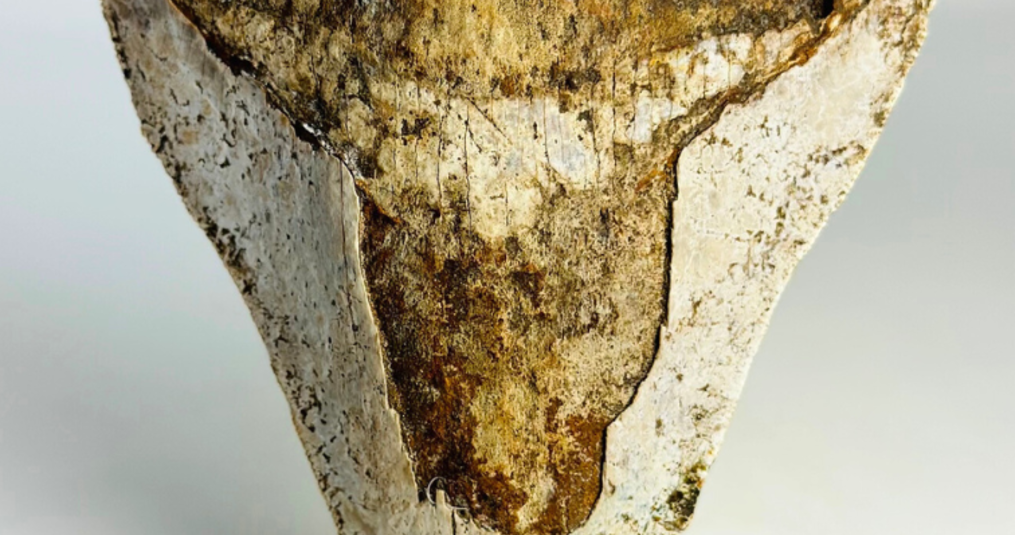
If you have ever held a Megalodon tooth, then you know you had something special in your hand. A massive, heavy and, above all, triangular-shaped weapon that the shark surely had hundreds of at a time. These teeth tell a lot about the great predator that was once THE ruler of our oceans.
Now, of course, the question is, how do you get such a fossil? Can you find Megalodon teeth yourself? If so how do you go about it? In this blog, we take a closer look at the world of diving expeditions in search of Megalodon teeth. We would love to explain to you what a Megalodon is and also how that you could look for it, we will look at the equipment and also the permits required. We also have a range of things for you to consider as an adventurous collector.
What is a Megalodon tooth?
The Megalodon was a gigantic shark which was estimated to have reached a length of between 15 and 20 metres. This means that the shark would have been about three times the size of our current great white shark. So this was in itself a colossus of the ocean and it lived some 23 to 3.6 million years ago and was the true apex predator. The Megalodon had a bite force that is estimated to have been stronger than that of any other predator in our history. The Megalodon was known to hunt whales, large fish and other marine animals.
The teeth of the Megalodon, which could reach a length of 18 centimetres, are really the most famous and best-preserved remains of this magnificent and impressive animal. The reason for this is that everything else from the Megalodon consists mainly of cartilage, which is a material that simply cannot fossilise. Therefore, this is the reason why you can actually only find teeth. Fortunately, we have super many available: these could lose tens of thousands of teeth in their lifetime and also replace them.
We know that a true Megalodon tooth is triangular in shape and has jagged cutting edges. In addition, the tooth also features a sturdy and especially wide root. The jagged cutting edges helped the Megalodon to effortlessly cut through bone and also meat. Did you know that the colour of a fossilised tooth can vary from black to grey, brown and even blue. This depends entirely on the minerals the tooth has been in for millions of years. Some of these teeth have a beautiful and shiny surface. When these teeth are also intact, they really become incredibly popular with collectors.
The large and well-preserved teeth can indeed be worth thousands of euros, this especially when they have sharp serrations, undamaged roots and are also crack-free. Yet even the small damages have their own charms and these also each tell their own story about life in the ancient and prehistoric seas.
Why are Megalodon teeth still being found?
The reason we still find Megalodon teeth is because these giant sharks occurred for millions of years in all relatively shallow and warm seas all over the world. These sharks lived in the Miocene epoch and also the Pliocene epoch. This was a period from about 23 to 3.6 million years ago. These were times when large parts of today's continents were still underwater. As a result, their fossil remains can be found at locations that today are far from the ocean, such as riverbanks, cliffs and even inland gravel pits.
Just as the modern white shark replaces its teeth, the Megalodon did so continuously throughout its life. If we estimate how many teeth one shark could have lost, we quickly arrive at a figure of 40,000 teeth, which were lost and replaced at the same time. These teeth in turn fell to the bottom and ended up here under a layer of sediment. Over time and also due to the right conditions of pressure, temperature and also minerals, the teeth were able to fossilise. So this means that the organic material was replaced by minerals from the surrounding rocks, this preserved the teeth as hard and stony fossils.
Geological processes such as erosion, landslides and also tectonic shifts have really exposed many of our ancient sea beds. Here, rivers cut through the earth's layers and in turn release fossils. On coastal areas, for example, we see sediment washing away, this causes fossil layers to become accessible to divers. Some of these prolific deposits are nowadays several tens of metres underwater, these sites are extremely suitable for the experienced sport diver.
Also, our human activity really plays a big role, just think of digging, dredging projects or even mining. This regularly uncovers fossils that have lain untouched under our earth for millions of years. Fossil hunters and divers know exactly what to look for and make good use of it.
In a nutshell, it is actually a combination of natural processes and also biological properties of the Megalodon itself. This combined with our modern techniques and knowledge. This ensures that we continue to discover new fossil teeth today. With a little bit of luck, commitment and also knowledge, you too can surely find one.
Where can you find Megalodon teeth?
By no means every sea or even river is suitable for finding Megalodon teeth. The chances of finding them are greatest in locations where that you have access to deposits from the Miceen or Pliocene era. These were the eras in which the Megalodon lived. We are going to take a closer look at some known sites:
- North Carolina, United States
Especially in North Carolina, we know that there is a real hotspot present as far as Megalodon teeth are concerned. The dive sites along the coast, this like near Wilmington or along the Cooper River in South Carolina (just across the border). These are places that regularly produce finds of large and also well-preserved teeth.
- Florida, United States
In addition, Florida, especially the Peace River and also along the west coast, are also places where many Megalodon teeth are found. Here, you often find them in rivers and also in offshore diving expeditions.
- California and Mexico
Here you will find teeth mostly along the west coast of North America, think San Diego and Baja California. These are places where you will find fossil layers in the ocean where teeth are regularly unearthed.
- Southern Europe and Africa
Did you know that you can also find teeth in parts of Spain, Morocco and even South Africa? These are places that are less accessible to divers, though, and also not well researched at all.
Can you find a Megalodon tooth yourself?
The easy and especially short answer is: yes you can. Still, it requires preparation, experience and a lot of luck anyway. People who often find teeth themselves generally do so on organised diving expeditions or under the guidance of an experienced guide. Yet we also have several enthusiastic hobby divers roaming our world who have enough knowledge and also easily make their own finds.
What do you need to look for yourself?
Let's look at the most important aspects and especially those you need to be able to look for yourself:
- Diving experience
The most important thing is that you have a valid diving certificate, this preferably a PADI open water diver or a lot higher. Many dive sites where you can find Megalodon teeth are located at depths between 10 and 30 metres, often even deeper. Good diving experience and especially self-confidence underwater are of unprecedented importance.
- Specialist diving equipment
Although standard diving equipment will get you a long way, some modifications are recommended:
- Heavy lead: You will often keep working on the bottom, sometimes even in the current. Extra lead helps to stay stable.
- Fossil bag or mesh-bag: To store finds safely.
- Gloves: For protection when digging or fumbling in sediment.
- Grab or shovel: For loosening sediment.
- Search techniques
You will rarely find the teeth on the loose seabed, to get to teeth you will almost always have to dig. You do this especially in places where the current has exposed teeth. We would like to give you some popular methods:
- Digging in fossil layers: also called gravel beds
- Sifting techniques: underwater
- Using an underwater metal detector: although this is less effective on teeth, which are not metallic
Diving expeditions: What Can You Expect?
The various organisations that offer special diving trips often have the fossils at their heart, we have listed below what you could and should expect.
- Day trips from the coast
As a rule, you are taken by boat to a location where that teeth have previously been found. You often do this in small groups with guides who know the area incredibly well.
- River diving
There are certainly expeditions that take place in rivers, this is something that offers a completely different experience than an ocean dive would. This is because you dive in murky water, often with a current, and you use your hands to really dig into the mud.
- Liveaboard diving holidays
Are you a real diving enthusiast? Then you can book multi-day trips on ships where you can make several dives a day. This is really ideal for people who are keen to do some serious searching or even find multiple fossils.
Laws and regulations
By no means everywhere is fossil collecting allowed, especially not on a retail scale. What we know about the US, for instance, is that the rules can vary considerably from state to state. In Florida, for instance, you are required to apply for a fossil permit if you want to search rivers. In South Carolina, certain dive sites have limited access and you will also need to have a permit.
In the Netherlands it is incredibly difficult to find Megalodon teeth, some have been found at some point in history, but don't worry importing and also buying Megalodon teeth is just completely legal with us in the Netherlands and also in Belgium. The only nuance here is that the fossil was not collected or traded illegally.
Before you want to do anything concerning fossils, it is simply important to check the local legislation carefully before starting your expedition.
How do you recognise a real Megalodon tooth?
There are an incredible number of teeth available on the market, yet you want to pay close attention when you find one. Let's take a look at how you can recognise a genuine Megalodon tooth:
- Shape: Clearly triangular, robust.
- Cutting edge: Often serrated - although the serrations may be worn off.
- Root: Solid and often slightly wider than the crown.
- Size: Anything over 5 cm can already indicate megalodon.
- Colour and luster: Fossil teeth often have a matt, earthy colour, depending on the sediment.
Note: of course, there are plenty of other fossilised prehistoric shark teeth to be found. Consider the Carcharocles angustidens or Carcharocles chubutensis These are teeth that are generally very similar to those of the Megalodon, to make sure you are dealing with a Megalodon tooth you definitely want to look at details such as shape and also serrations.
Conclusion
We at Megalodontand.nl know better than anyone else that diving for Megalodon teeth can be very adventurous and will certainly involve a bit of history and nature experience. After all, you are floating above a deposit millions of years old, so make no mistake about it. You will also go in search of tangible and ancient traces of a forgotten and vanished world. For those who want to immerse themselves in this special piece of palaeontology, a diving expedition is an experience you won't soon forget.
Whether you are an experienced diver or just starting fossil collecting, the world of the megalodon is open to those who dare to search. And who knows, you might just find that one tooth that changes everything.