

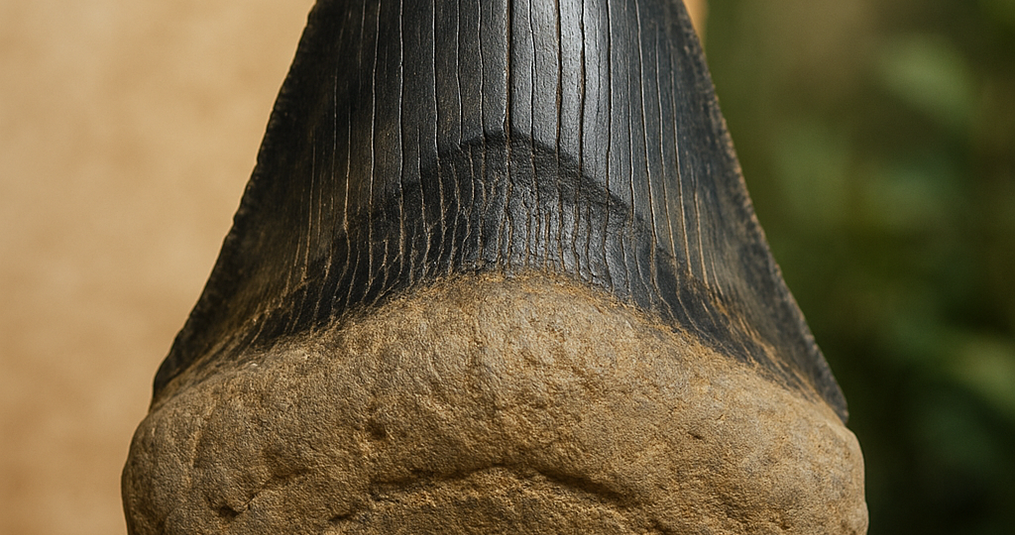
Who doesn't get feelings about the Megalodon? Except that these are feelings of fear or perhaps even overwhelm, but the Megalodon is known to evoke images of an ancient, gigantic and above all terrifying shark that roamed the oceans millions of years ago. The most impressive fossils ever found are the mighty and gigantic teeth of the Megalodon. You might also wonder what the teeth can tell us about our history? Why are they so fascinating to collectors, scientists and also nature lovers?
In this blog, we take you into the wonderful world of the Megalodon and explain why these teeth are so much more than just spectacular finds. These teeth are a window into a forgotten era, they also provide insight into evolution on earth and, in addition, they tell you how that the world evolved in itself and how that our planet and also its inhabitants evolved over millions of years.
What is a megalodon?
A Megalodon, also known by its scientific name: Otodus megalodon, prevailed in our oceans about 23 to 3.6 million years ago and was undoubtedly one of the largest predators that ever lived on earth. It is a shark that could indeed reach 18 metres in length, this more than three times the size of the white shark. This is the current giant that swims around our oceans today. The Megalodon was the absolute ruler of the seas.
What we know is that incredibly little remains of this shark. This is because sharks have a skeleton of cartilage. This is a material that fossilises many times worse than bones do. This is therefore the reason why most of the Megalodon's remaining fossils are its vertebrae and also its teeth. By the way, these teeth really do speak volumes.
A tooth as a time capsule
Did you know that a Megalodon tooth is not just another tooth, but that these teeth, with their jagged edges and beautiful and impressive structure, can seriously reach 18 centimetres in length? So the story of the Megalodon begins when you consider this tooth as a time capsule. All the fossil teeth of the Megalodon tell a unique story about the ocean world in which it once functioned.
Let's look at the different ways a megalodon tooth gives us insight into history:
Information on the era in which he lived
Because of the earth layers in which that Megalodon teeth are found, scientists can very accurately determine which period it comes from. This often involves the Miocene and also Pliocene eras. It is a time when the climate was also a lot warmer and sea levels were higher. As it were, this brings us a lot of new valuable information about the climate history of our earth and also how that our ecosystem has adapted to the changing conditions.
By finding the megalodon teeth, we can determine the migration routes that ran from the east coast of the US to South Africa and also Japan. This means the we can see how that the animals made their journey and also how that the waters merged, so to speak.
Evolution of predators
The fold of the Megaldon tooth can tell us an incredible amount about the function it had, for instance, you could say that the jagged edges of the teeth indicate that the Megalodon fed on large prey, this such as whales, seals and also giant squids. It actually points us back to a predatory fish that certainly had to possess intelligence in addition to strength, this would have been essential for hunting.
By comparing the megalodon teeth with those of the other prehistoric and also modern sharks, the palaeontologists can tell us how that the predators must have adapted to changes in their prey, environment and also competition. These are insights that in turn help to better understand our current marine ecosystem.
Changes in biodiversity
When we find Megalodon teeth in areas where no large predators currently live, it gives us information about certain changes in biodiversity that have taken place in that region. So we can find out why that shark disappeared, what that meant for the other species. In addition, we can also see which species have replaced the Megalodon shark, as well as any other animals.
Thus, there are theories that tell us that the rise of the modern whale and also competition from many times smaller and more efficient predatory sharks contributed to the eventual extinction of the Megalodon. So the tooth can help us in this indirectly by analysing its distribution and also size in relation to yet other fossils that occurred in the same strata.
The tooth as cultural heritage
Megalodon teeth often have cultural significance in addition to scientific value. Already during past centuries, these teeth were found, this without knowing exactly what they were. We know that in some cultures the teeth were mistaken for teeth of dragons or other magical and mythical creatures. Only with the emergence of modern palaeontology in the 18th and 19th centuries did scientists begin to put these finds in context.
We know that Megalodon teeth are not only loved by scientists, but also by collectors and also lovers of natural history. Thus, a Megalodon tooth in your possession can feel like a piece of prehistory. Something you own as a tangible connection to a world that is really long gone.
What does the tooth say about ourselves?
What we know about the Megalodon tooth is that it mainly tells us something about the past, this is an era when that that humans simply did not exist and it was an era when the ocean was dominated by the giant predators that we can really hardly imagine. If we look deeper, we know that the tooth also tells us something about ourselves, we mean by this that we are so curious and have such a desire to be able to understand where that we came from. In addition, we also just have a deep-rooted connection with nature and also its history.
The way we collect, study and also appreciate our fossils shows something fundamental of the human spirit. It is an urge to penetrate the unknown in order to create order out of the chaos of the past and also to recreate questions based on the fragments. For instance, a single tooth found in a riverbed or mountain range can inspire us to ask big questions, how did we evolve life on earth? How do we apply it to the bigger picture? What can this discovery tell us about the fragility and also the resilience of life on this earth?
In addition, a fossil can also show us how relative our current existence actually is. After all, we live only a fraction of the millions of years during which species such as the Megalodon roamed our earth. Yet, through every piece of the past we can find, we want to come to understand the big story. This makes found fossils not only incredibly important for science, but also as a philosophical significance. These confront us with time, with impermanence, but also certainly with connection. The thing is, although we have never seen the Megalodon in the flesh, we have shared the same earth and also oceans, and we are surely going to share the same fate one day.
Perhaps it is an incredibly powerful message from a Megalodon tooth. Then I am also talking about the fact that the past will never really disappear. After all, it lives on in stone, in stories and also questions we keep asking. Besides being able to reconstruct the past, it also helps us understand ourselves better. This as a kind of story that is much bigger than just our story.
The tooth in practice: how to recognise a real one?
We know that Megalodon teeth are incredibly sought-after collectibles, yet of course you can find forgeries and also replicas of these teeth. This often on and auction site or a marketplace. Extra caution is therefore required here. Should you ever consider buying a Megalodon tooth, whether as a beginner, collector or simply enthusiast, make use of a few important characteristics to look out for:
- Size and weight: A genuine Megalodon tooth is often heavy and, more importantly, massive. These teeth feel solid in the hand and also have a very robust structure. This often with a very clear transition between the root and also the crown. Replicas are often lighter because they are made of plastic or resin. In addition, you can also just simply see this, this as you have several teeth in your possession.
- Colour and surface: Fossil teeth often have a more matt and, more importantly, weathered appearance. The teeth can vary considerably in colour, this depends entirely on where they have been in the ground and also the mineral content. So you may see grey, black, brown or even red or bluish.
- Serrated edges: We know that well-preserved teeth often have distinctive and finely serrated edges and so these may still be visible. These were serrated edges that were really essential for tearing the flesh and are also often super difficult to recreate in replicas. Wear is normal, but sharp and asymmetrically worn serrations can indicate possible authenticity.
- Provenance: We always love to give you the location where that tooth was found. This can add not only to the authenticity but also to the story behind it. Thus, we will be more than happy to give you information about the tooth and also stamp it with a COA. The reason for this is that we are 100% behind the divers, miners and also suppliers.
On our website, you will only find genuine, carefully selected fossils, including detailed provenance information and a certificate of authenticity. So you can be sure that you are holding an authentic piece of prehistory, this with a story going back millions of years.
What can we learn from the extinction of the megalodon?
Did you know that the Megalodon's extinction is still a real topic of debate? Could it have been climate change? A lack of prey? Perhaps competition from the emerging orca or white shark. It may even be that the drop in sea levels played a huge role, as this could result in the Megalodon's hunting grounds gradually disappearing. It was probably a combination of these factors that combined to cause a chain reaction in the ecosystem.
What it really taught us is that even the most powerful animal in the world is not invincible. These are also just at the mercy of environmental changes. Size, as well as strength and dominance, really do not guarantee survival especially when the natural balance is disturbed.
It really is an important insight, this especially if we as humans are now at the same helm as the Megalodon did before in a sense. In our case, think about global warming, pollution of our oceans and also the loss of biodiversity. It is the history of the Megalodon that reminds us that the balance of nature is so incredibly fragile. In addition, we also learn that the departure and hence disappearance of one species can have far-reaching consequences for the overall ecosystem. All of us together, big or small, play a role in the overall picture. The story of the megalodon is thus not only a retrospect, but also a warning and a lesson for the future.
Conclusion
We at Megalodontand.nl know better than anyone that it is so much more than just an impressive fossil. In fact, it is a tangible reminder of a time when the earth really looked different. A time when giant predators roamed the oceans. It also tells a story about our evolution, change and also how vulnerable even the most powerful creatures can be.