

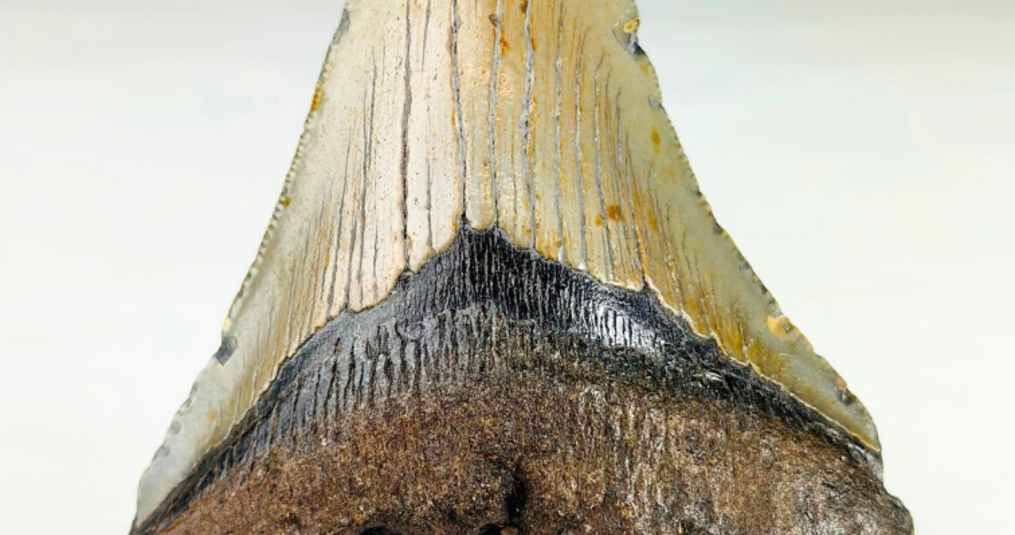
A Megalodon is a name that can really capture the imagination. It is a gigantic shark that can conjure up images of truly enormous jaws, super sharp teeth and also an impressive hunter that ruled the oceans for millions of years. So what do we really know about this gigantic and legendary hunter? An awful lot of what we know today about the Megalodon comes strictly from its teeth. Think about the shape, size and also the wear and tear of the Megalodon's teeth. All this information gives us a perfect picture about its lifestyle, diet and also even its role in the ecosystem millions of years ago.
In this blog, we are going to delve a lot deeper into the world of Megalodon teeth. In doing so, we will look at the question: What can the shape of a Megalodon tooth tell us about its lifestyle? In addition, you will discover that these ancient fossils can tell us more than you might think at first glance. What does the shape of a Megalodon tooth tell us about its lifestyle. You will discover that these ancient fossils have more to tell us than you might think at first glance.
What is a Megalodon?
Before we really look at the details of the tooth structure, it is very good to be able to take a moment to reflect on the animal itself. For instance, this shark lived during 23 to 3.6 million years ago. This from the Miocene to the Pliocene epoch. The shark had an estimated length of 15 to even 20 metres. The Megalodon was undoubtedly one of the largest predators ever to swim in our oceans.
What makes a Megalodon so fascinating is that virtually nothing remains of this giant's skeleton. Like the modern shark, its skeleton consisted mainly of cartilage, this is something that rarely remains fossil. What we can actually find are the teeth and this too in large numbers. Fossil Megalodon teeth are found all over the world, this from the east coast of North America to the coasts of Europe, Africa, Australia and even in the Netherlands.
Why were only the teeth left?
The reason we find so many Megalodon teeth, this while other parts of the Megalodon are incredibly rare. This is purely because of the material it is made of, namely cartilage. The teeth, in turn, are made up of dentin and enamel. These are things that, as a rule, can fossilise perfectly. An adult Megalodon could easily lose and also replace thousands of teeth. So this ensures that today we are more likely to find fossil teeth than any other things.
The abundance of teeth in this case is not just archaeologically interesting, it is also a goldmine of information. This is where the real magic comes from then, because here's the thing: the shape of the tooth tells us something about the lifestyle of the massive shark.
The shape of a Megalodon tooth
I think we all currently know the shape of a Megalodon tooth, triangular, a wide root and also sharp jagged edges. There are specimens which are bigger than an adult human hand. Yet we can glean a world of information from this brutal piece.
Let us analyse some aspects of the tooth shape:
Triangular shape with wide base
The Megalodon tooth naturally has its triangular shape, which is wide at the bottom and narrow at the top. This is quite typical of a predator that bites its prey and also tears it into pieces. Unlike to those elongated and pointed teeth you often see on fish-eating sharks. These triangular teeth are designed to cut powerfully through flesh and bone.
This shape suggests that the Megalodon was an active hunter that targeted large prey. Think whales, dolphins, manatees and other large marine animals.
Serrated edges (Serrations)
Most Megalodon teeth have very fine serrated edges, you can compare it to those of a bread knife. These are serrations that helped perfectly with cutting through flesh efficiently. We also see this in modern white sharks. The presence of these serrations indicate a diet of meaty prey. Here, the teeth act as a knife to cleave muscles, tendons and also bones.
Variation in size and thickness
What we can mention with certainty is that really not all Megalodon teeth are identical. You have very small and wide, but also long and slender teeth. Some are more elegant and others are more robust. The researchers suspect that these differences mainly indicate age stages and probably the difference between male sharks and female sharks. The difference could also be due to regional differences in diet.
For example:
- Younger Megalodons may have had smaller, sharper teeth suitable for fish or smaller marine mammals.
- Adults had the more powerful teeth needed to bite through the thick tissue of large whales.
Wear and dentition
Tooth wear can also provide us with an insight into the Megalodon's lifestyle. For instance, there are teeth that can show considerable weathering and heavy use. Think broken serrations, worn tips and even the cracks. This type of wear basically amounts to repeated contact with hard objects. Think bones or shells. You can see here typical behaviour of a predator devouring large and bone-rich prey.
Comparison with other sharks
To really understand what the tooth shape tells us, it is useful to look at other shark species, for this you want to look at living variants and fossil variants.
White Shark (Carcharodon carcharias)
The white shark is often seen as a modern counterpart of the Megalodon. Its teeth are quite similar to those of the Megalodon in terms of shape, being triangular and serrated. Yet they are obviously considerably smaller. Incidentally, the Megalodon and the white shark had an almost similar diet, namely marine mammals. The tooth shape naturally reflects that same diet.
Tiger shark (Galeocerdo cuvier)
The tiger shark again has wider and somewhat more curved teeth with very coarse serrations. These teeth are adapted to eat a variety of prey. Think fish, birds and even sea turtles. What these teeth tell us is that the tiger shark must have been a very opportunistic omnivore. This is in contrast to the Megalodon which specialised in hunting big game.
Hunting techniques
Due to the combination of strength, serrations and, above all, size, scientists suspect that the Megalodon used specific and also very efficient hunting techniques. This is in contrast to other predators. It would not have simply bitten at random like this. The Megalodon would have to have a much more sophisticated and well thought-out strategy. Thus, the Megalodon would have targeted the more critical areas of its prey. Think especially of the chest, fins or even the tail. Anything to quickly paralyse the prey. It could take away the prey's swimming power and a bite in the chest could also be fatal because of all the damage to the vital organs.
A single, powerful bite from the Megalodon was probably more than enough to seriously injure or even kill an adult whale. In the process, the jagged edges of the Megalodon's teeth acted like a meat cleaver. These teeth effortlessly cut through skin, fat and muscle tissue. The corresponding serrations in turn ensured that the bite was not only powerful but also highly destructive. This especially when cutting through tough structures such as tendons and also cartilage.
What makes the Megalodon's hunt that much more impressive is that it was accompanied by the enormous power of its jaws. Indeed, scientists estimated that the Megalodon must have had a biting power that amounted to a good 18 tonnes. In doing so, it would have had to crack the thickest bones with ease. You also currently cannot really compare any living or extinct animal to what this monster shark could manage. With the power the shark had, it could break ribs, damage the spine or simply tear whole pieces of flesh loose from the prey in one attack.
Also, a Megalodon should have been a master of stealth. Something we cannot imagine given its length and behaviour. This would have allowed them to easily approach their prey from below or from behind. These would be places where that the prey was least protected. Besides, in an open ocean, where that flight is difficult, such a strategic attack could make the difference between a failed hunt and also a successful meal. This advanced way of hunting indicates a predator that was not only physically dominant, but also possessed a degree of intelligence and adaptability.
Fossil finds as evidence
Through possible examination of fossilised whale skeletons with bite marks, this clearly shows that these animals must really have been victims of Megalodon attacks after all. In addition, the bite marks perfectly match the pattern and dimensions of Megalodon teeth, something that thus again confirms this hypothesis.
We know that skeletons have even been found with healed bite wounds. This should suggest that there were whales that should have survived such an attack. But the presence of such marks shows that the Megalodon actively hunted these large animals. In addition, the toothvom was perfectly suited to this way of hunting.
What else can we infer?
Besides information on diet and also hunting techniques, we can draw so many more interesting conclusions about the life of the impressive shark species from the shape and distribution of Megalodon teeth. These teeth act as a kind of biological time capsule which will give us insight into its habitat, growth patterns and also its global distribution.
- Where the Megalodon lived:
Megalodon fossils are incredibly often found in sedimentary layers that used to be part of warm, coastal seas. These are regions that are often shallow, tropical or subtropical waters. These were particularly rich in prey animals such as whales, dolphins and also large fish. This presence of the teeth in these areas just goes to show that the Megalodon was incredibly fond of being in food-rich areas with sufficient cover and also hunting opportunities. It confirms the image of a predator that again settled strategically where the chances of a successful hunt must have been greatest.
- How he grew:
By comparing teeth of different shapes and also sizes, scientists can reconstruct the Megalodon's growth curves. The younger sharks often had smaller and sharper teeth. These were possibly more suitable for catching the somewhat smaller prey. As the animal got older, the tooth structure changed with wider and more robust teeth that were suitable for handling larger prey. Some fossil sites are also full of teeth from younger Megalodons. These may have been places where that young Megalodons grew up. Nice and safe in shallow waters, this before they moved to the new deep water as adults.
- How his population spread:
The gigantic distribution of Megalodon teeth, from North and South America to Europe, Africa, Asia and also Australia actually shows that the Megalodon was everywhere. In addition, it can also tell us what the temperatures were like all over the world, this considering the Megalodon mainly liked the slightly warmer temperatures. So the Megalodon was almost everywhere and its distribution again shows that it was a highly mobile species. It was probably able to travel long distances in search of food or again suitable breeding sites. So in addition, the Megalodon also had an incredibly broad role in the ecosystem worldwide.
Conclusion
We at Megalodontand.nl know that a fossil tooth is so much more than just a fragment of a vanished legend. Yet it is also another window into the past. The shape of the tooth can tell us that the Megalodon had been a perfect and masterful hunter. It was built for strength, efficiency and dominance. Each serration, wear surface and angle gives us hints about its behaviour, diet and lifestyle.