

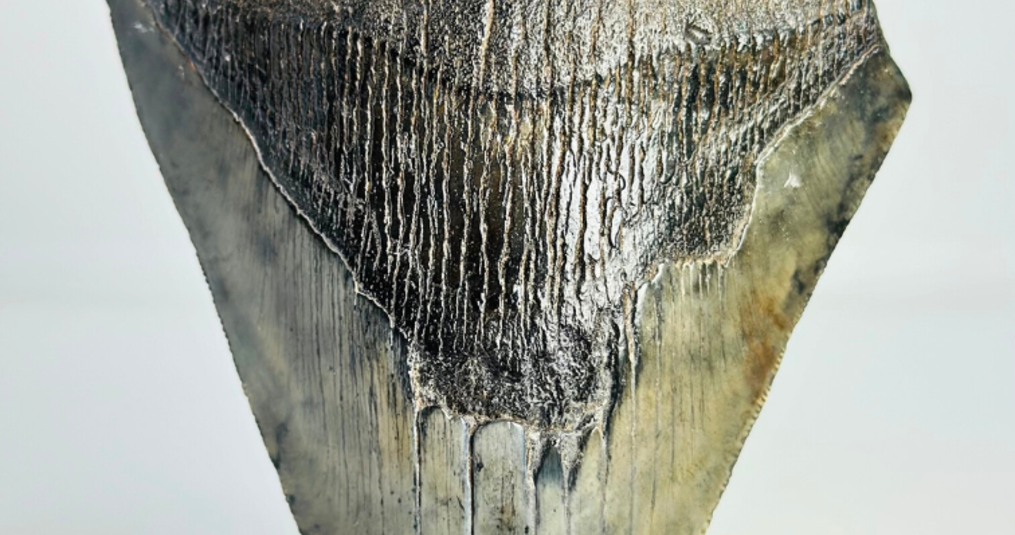
We all know that Megalodon teeth can capture the imagination in a fantastic way. After all, the teeth are not only immensely large but also simply millions of years old. You just have a piece of prehistory in your hands, so to speak. So today we are going to take a look at what you can/should do when a tooth has fallen out of your hand. We understand better than anyone that the moment this happens, questions arise such as, what happens then? Is it broken? Is the tooth permanently damaged? Or is it not that bad?
In this blog, we will take a closer look at the beautiful and unique world of Megalodon teeth and we will also explore exactly what happens if you were to drop one. We are going to talk about the structure of the teeth, age, possible damage, as well as what you can do to recognise and prevent the damage. We also want to look at what you can do if the tooth did fall. Believe us you are really not alone in this, there are more who have wondered or even experienced it.
What is a Megalodon tooth anyway?
Of course, before we can really delve deeper into what happens when you drop a Megalodon tooth, we need to take a closer look at what exactly a Megalodon tooth is.
We know that the Megalodon (officially: Otodus megalodon) was a prehistoric species of shark that dominated the oceans until about 3.6 million years ago. The Megalodon had a length of about 18 metres long and was also one of the largest predators that ever existed. Like all other sharks, the Megalodon had magnificent teeth, this consisting of hundreds of teeth that could always be replaced.
A Megalodon could easily lose and also replace as many as 20,000 to 40,000 teeth during its lifetime. This is therefore the reason why we can find so many fossil teeth here and then all over the world. Think of the US, Morocco, but also the Netherlands and Indonesia.
Megalodon teeth are incredibly easy to recognise by their huge size (this up to 18 cm long), triangular shape, sharp serrated edges and often beautiful colouring. The latter, of course, has everything to do with the sediment in which they were fossilised.
How sturdy is such a fossil tooth?
We therefore also have a very logical question for this blog, how fragile is a Megalodon tooth really?
The short answer we can give is that it depends on the conditions. This is because a fossil tooth is not the same as the common teeth of living animals. During millions of years since the Megalodon's death, the original tooth material has largely been replaced by minerals that come from the environment in which the tooth was buried. This process is called natural fossilisation and is a slow and also natural process that turns an organic tooth into a kind of stone imprint of what once was.
During this fossilisation, the organic components such as detine and enamel are replaced, so to speak, by minerals such as calcite, quartz, iron oxide and even silica. This composition of minerals is entirely dependent on the type of rock or sediment the tooth ended up in, in addition, the chemical composition of the groundwater also does an incredible amount. This makes each fossil tooth unique in colour, texture and also hardness.
At first glance, a fossil Megalodon tooth will feel pretty solid. Many of the teeth are hard and also fairly heavy, looking just like a stone, so to speak, and also feeling heavier than you would have expected. Yet this apparent robustness will be incredibly misleading. The process does petrify the teeth, but make no mistake, they have also become more brittle.
You can best compare the teeth to a piece of porcelain or ceramic. It is incredibly hard and also feels incredibly solid. It could be that with a wrong blow or fall on a hard surface, the tooth will easily break, chip or even crumble. This is especially true of the fossil teeth of the Megalodon and especially if they are millions of years old.
Why are fossil teeth more brittle than you think?
It's mainly in the internal structure here. SO a modern tooth can still be partly flexible. This is because it consists of enamel, detine and also a core of living tissue. This structure can absorb some shocks. A fossil tooth, of course, no longer has this. Mineralisation has replaced the original longs with a kind of crystalline structure, which have absolutely no elasticity. The result? A tooth that feels incredibly hard, but can still easily crack or break into pieces on impact.
Factors affecting fragility
Let's take a closer look at the different factors, which determine how fragile a fossil tooth is. By no means all Megalodon teeth are equally fragile. There is mostly nuance in this case too, this makes the subject even more interesting for collectors, enthusiasts and also museums.
- The age of the tooth
Although we know that all Megalodon teeth are millions of years old anyway, ranging from around 3.6 million to 20 million years, it is nevertheless incredibly good to know that by no means all teeth have been in the same conditions. There are teeth that have only recently been found, others have long been excavated or have been exposed to erosion with some regularity.The longer a tooth has been subjected to natural influences such as temperature variations, humidity or salinisation, the more likely it is that microfractures or structural weaknesses have developed.
- The site of discovery
The geographical origin of a tooth can greatly influence its physical properties. For instance, a tooth may have been found in river deposits, consider Florida or South Carolina, for example. These teeth are more often better preserved than a tooth from a more sandy coastal area. Here you will see that erosion and also salt action does much more damage. Also, teeth from deep-sea excavations or from muddy layers often have less external damage and are sometimes surprisingly well preserved.
We know that in the Netherlands, teeth are sometimes found in dredged mud from the North Sea or in deposits in, say, Limburg. These in turn can be really surprisingly beautiful, but don't forget that they can also be incredibly fragile. It depends entirely on the geological composition of the area.
- The mineralisation
We know that the exact minerals intruded during the fossilisation process make a big difference in hardness and also brittleness. For instance, a tooth that has been largely converted into quartz minerals can often be rock hard, this can therefore withstand a fair amount of impact. Teeth lying in sediment where mainly iron oxide predominates can again be incredibly hard on the surface but again incredibly brittle internally. In this case, it can be compared to a stone with a hollow core.
The colour of that tooth also gives another hint, black teeth often come from oxygen-poor and especially muddy layers. These teeth are often much more heavily mineralised. If you have teeth with a brown or yellow glow, then you know they have been in ferrous minerals. We know that any colour will always contribute to the story and will also be able to tell something about the physical state of the tooth.
- The thickness and size of the tooth
Surely we would normally assume that the bigger teeth tend to be a bit tougher, yet the opposite is true here. This is because the big teeth are a lot heavier and this weight works against them, especially when they take a fall. Because of this extra volume and also mass, more force is released during a fall. This increases the chances of cracking and breaking. In addition, the larger teeth tend to have somewhat wider roots. These are more likely to split on an unfortunate landing.
The smaller teeth again have less mass and are therefore many times more flexible due to the compact structure. Although they remain fossil material and will always be sensitive to impact.
- The state it is already in
A tooth that has some visible hairline cracks or chips broken off will generally be more susceptible to more damage than complete pieces, don't forget the invisible damage and especially the internal damage, which is caused by millions of years of pressure, ground movement or exposure to oxygen. This can cause a tooth that looks perfect to crack on impact from a fall.
Therefore, it is always advisable to treat teeth with care, no matter how 'whole' they look. Prevention is the key word with fossils.
Are there any teeth that can withstand impact?
Yes, there are always exceptions, so there are teeth that have fossilised incredibly well, often as a result of a range of favourable conditions. These include a constant temperature, little acidity in the groundwater and also a sheltered location in clay layers. These teeth can be incredibly sturdy and thus survive a fall on a wooden or hard floor covering without damage.
But even these relatively strong teeth need to be treated with care. As strong as the teeth may seem, they are nevertheless fragile and, above all, silent witnesses of an ancient time when many animals had yet to emerge, but also a time when continents were spread across our planet in other forms.
What happens if you drop the tooth?
Suppose you let a Megalodon tooth slip out of your hands. What then are the possible scenarios?
- No damage
If you are lucky, the tooth falls on a soft surface (such as carpet or grass), or in a way where it does not land with full force on a point. In that case, you'll probably get off incredibly well.
- Chipped tip or edge
Surely the damage you will encounter most often after a fall is a broken-off tip or a piece of the side. This often happens to teeth with already some age-related cracks or teeth with sharply defined edges. It is aesthetically unfortunate, but it does not necessarily mean that the tooth is worthless.
- Cracking
Sometimes you won't see any damage at first glance, yet an internal crack or hairline crack may be present. This in turn can lead to further damage if the tooth is later moved or touched again.
- Complete fracture
In the worst case, the tooth breaks into multiple pieces. This usually happens when the tooth falls on a hard surface (such as stone or concrete) and already showed some fragility.
What can you do if the tooth is damaged?
You dropped the tooth. It is damaged. What now?
- Stay calm: It's annoying, but you're not the first. And you probably still have an impressive piece of history on your hands.
- Inspect the damage carefully: With good light and possibly a magnifying glass, look for cracks, chipped pieces and cracks.
- Keep all broken off parts: If a piece is broken off, don't throw it away! This can often be reattached with special glue or restoratives. Or just keep it.
- Have it professionally restored: There are specialised fossil restorers who can restore damaged fossils without it being visible to the naked eye.
- See it as part of the story: A damaged tooth also tells a story. In some cases, it even adds character to the fossil. A small crack or chip need not immediately destroy its value or beauty.
Conclusion
We at Megalodontand.nl unfortunately know that dropping a Megalodon tooth is by no means a rare accident, but it's really not a disaster either.
The outcome depends on many factors, the hardness of the surface, the condition of the tooth, and the angle of impact. Damage ranges from slight chips to complete fractures, but there are ways to prevent damage as well as to restore or still value a damaged tooth.