

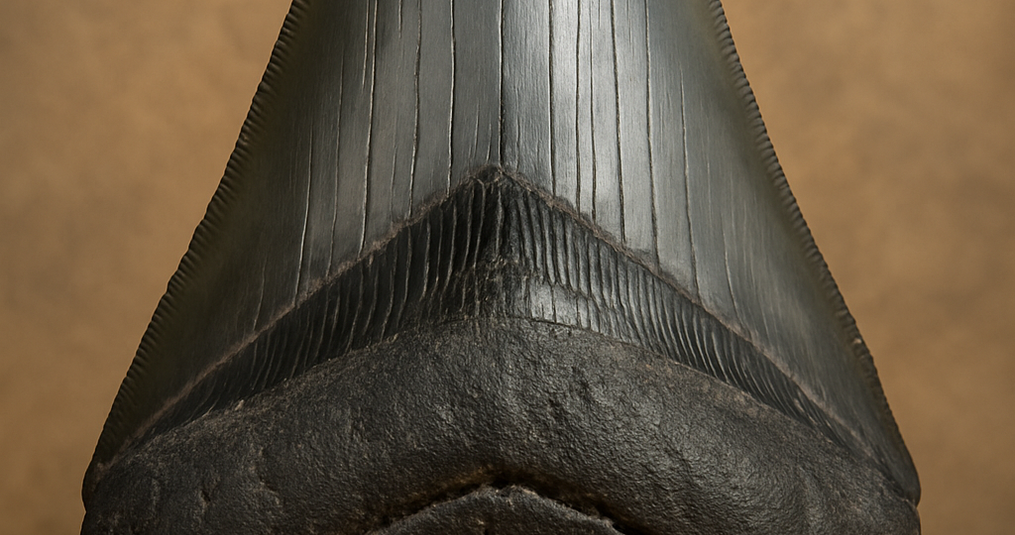
You know it when you've ever held a Megalodon tooth in your hands, after all, it's not just a fossil. It is also an impressive piece of history. It gives you the sense and tangibility of the power and mystique of an extinct super predator. Why are these teeth so desirable anyway? What determines their value? What makes them so special when you compare them to other fossils?
In this blog, we will take a look at it with you We will look at the origins, rarity and even the factors that determine the value of teeth, and in addition, we will also look at why that for some people they are so much more than just a collector's item.
1. The megalodon was a prehistoric giant
To fully understand why Megalodon teeth are so valuable, we must first take a closer look at the animal itself. For instance, the Megalodon, also known as the Otodus Megalodon, was a huge shark that dominated our oceans. It was a shark that could reach a length of 18 metres, which is simply 3 times the size of an adult white shark. Incidentally, this Megalodon had a mouth that was large and also wide enough to devour an adult human in one bite. In addition, its teeth also had a length range of 18 centimetres long. This was undoubtedly one of the most formidable predators that ever lived.
The large and mystical Megalodon was known to swim in almost all the world's oceans and mainly fed on whales, dolphins and also other large marine animals. The teeth that the Megalodon possessed were not only gigantic, they were razor-sharp and perfectly shaped to grab and dismember prey. It is true that sharks lose and replace teeth throughout their lives, which is how millions of Megalodon teeth have been left in our earth's strata. Still, large, well-preserved specimens are rare as well as sought-after.
2. Fossil teeth are tangible relics from another time
We know that teeth are largely composed of enamel and dentin. These are two hard, mineral substances that are more resistant to the ravages of time than all the cartilage the shark's skeleton is made of. This is the reason why you hardly find any skeletal remains of the Megalodon. The gigantic body, which is composed of cartilage, simply cannot be preserved well enough in the earth's strata to become a fossil. So what we do find an awful lot of at the moment are the teeth, sometimes single and sometimes in small clusters. This is scattered across different continents and sedimentary layers.
This is why these fossil teeth are our main, most tangible link to our prehistoric predator. All these teeth tell their own story about life millions of years ago. A story about oceans that have completely disappeared today, prey that no longer exist and a shark that became a true apex predator because of its strength and size. Holding a Megalodon tooth in your hands is like being transported back to a world where humans did not exist and the seas were ruled by giants.
As impressive as the idea is, it obviously does not mean that every Megalodon tooth is automatically rare or valuable. We know that millions of teeth are found around the world, ranging from small, broken pieces to perfectly preserved large-sized specimens. This true value of the fossil tooth is determined by a combination of factors. The world of Megalodon teeth has really raised the bar. This is not just because of the competition among collectors and enthusiasts, but also because of the range of truly unique large teeth. After all, these are often smaller than people think.
We will therefore take a closer look at the most important aspects that determine how valuable a fossil tooth actually is. To do so, we start with perhaps the most obvious factor, namely size.
3. The bigger, the better
Of course, the first thing the seasoned collector and also seller looks at is the size of the tooth. This is not surprising, of course, as Megalodon teeth can get really beautiful. The bigger that tooth is, the more that it naturally captures the imagination. Most teeth found this way are between 5 and also 12 centimetres long. These are quite large sizes, this when you compare them to the teeth of modern sharks. If we look at the world of Megalodon fossils, they only belong to the middle range.
A tooth of more than 15 centimetres, on the other hand, is really a great exception. These are specimens which are less common and therefore automatically rarer and also more valuable. These are teeth that often belong to specimens of Megalodon that fell into the largest sigment of the species and should often reach 18 metres in length. Here, then, the size of the teeth is associated with the size of the shark itself. Yet the tooth does capture the imagination even more. After all, you are not just looking at a fossil, but physical evidence of an animal that is barely comprehensible in terms of size.
The teeth that reach a length of 17 centimetres or even more are the really rare factor. We know that only a few dozen of these specimens are known in the world. This therefore makes them highly sought-after collectibles, this for serious collectors, museums or even investors. After all, these are all looking for real eye-catchers with a high historical and, above all, emotional value. These are the teeth that can easily reach prices of thousands or even tens of thousands of euros. Of course, this depends entirely on their condition.
We know that the largest tooth ever found had reached as much as 19 centimetres in length. These types of teeth are not just collectibles, but are really considered cultural and also scientific heirlooms. Some of these specimens are included in museum collections and are rarely, if ever, offered for sale.
By the way, it is important to mention that the size of the tooth is not all-important. We will go into more detail on this further in the blog, but the condition, symmetry, colour and also provenance play an incredibly important role. A 16-centimetre tooth with severe enamel damage or a broken tip will often be worth less than a smaller 13-centimetre tooth that is in perfect condition.
4. Condition and quality
We now know that the size of the tooth is not automatically all-important for its value. The condition of the tooth is certainly just as important. Many of the teeth are found broken or even damaged. This makes sense, of course, as they have been around for millions of years and are often swept or moved in the sea. Teeth that are completely intact, without cracks or broken edges are also really scarce.
Important quality factors include:
- Completeness: Is the tooth complete, including the root?
- Enamel: Is the glaze flawless and shiny?
- Serrations: are the fine serrations on the cutting edge still visible?
- Symmetry: Is the tooth nicely shaped, with no curvatures or asymmetric wear?
A perfectly preserved, symmetrical megalodon tooth of great size is a dream find - and that is reflected in its value.
5. Colour and appearance
A much lesser known and especially not unimportant factor is the colour of the tooth. Often Megalodon teeth are grey, reddish or black. This depends entirely on the sediment in which they were fossilised. Sometimes, however, we do see teeth in very unusual colours. Think blue, golden brown or even a light green hue, due to the minerals in the soil.
We know that colours have no direct impact on scientific value, yet it certainly plays a role for the collector. For instance, a tooth with a unique colour or an eye-catching pattern can attract attention and therefore also fetch a higher price.
6. Origin and location
By no means every Megalodon tooth comes from the same area, of course. We know that they occurred in all the world's great seas, so we have listed the most famous finding places for you. Let's take a brief look at these together:
- South Carolina and Florida (USA): Here, many teeth are found in rivers and along coastlines.
- Morocco: An important country for fossils, where megalodon teeth are also regularly unearthed.
- Peru and Chile: Less common, but high quality.
- Europe (e.g. in parts of the Netherlands): Rarer, but megalodon teeth have also been found here, especially in gravel deposits.
Teeth from certain regions are valued higher, especially if that region is known for its exceptional fossils. Whether a tooth was legally and responsibly extracted also plays into its value. Ethical collecting is gaining importance among fossil enthusiasts.
7. Rarity and demand
Of course, the law of supply and also demand also comes into play. Although there are many Megalodon teeth in circulation, there is a limited market for the genuine, especially beautiful specimens. Teeth of 10 cm and larger in good condition are incredibly rare. You want to add to that the growing interest for collectors, museums and also enthusiasts worldwide. This makes it all clear, why that the price keeps rising.
In addition, fewer and fewer new sites are becoming available. For instance, some areas have become protected nature reserves. Where in other places commercial on scientific excavations have been stopped. Of course, all this makes it a lot harder to find large and cool megalodon teeth and therefore a lot more valuable.
8. Emotional and symbolic value
Besides the mainly objective characteristics, such as for example: the size, colour and also condition, there is of course also a subjective side to the value of the Megalodon tooth. For an awful lot of people, it is more than just a fossil. It is a tangible piece of prehistory, a connection to an animal that was an apex predator in our world's oceans for millions of years.
For some, owning a Megalodon tooth is a true symbol of power, mystery or adventure. For everyone else, of course, it is a valuable addition to their collection, a way to express a love of palaeontology and so much more. Besides, you can also give the teeth as a gift, it is a unique and unforgettable gift with a story.
9. Investment or passion?
There are also collectors who see a Megalodon tooth purely as an investment opportunity. This is understandable, of course, as the value of rare fossils has only increased substantially over the past few decades. For most enthusiasts, passion plays a super big role. Collecting Megalodon teeth and fossils in general is simply a hobby that involves a lot of fascination and wonder.
This is exactly what makes teeth so incredibly valuable, not only in euros but also in meaning. These put people in touch with the deepest and also oldest history of our planet, in addition they also give a sense of scale and time that few other objects can match.
Conclusion
We at Megalodontand.nl know that a Megalodon tooth is so much more than just a fossil, it is simply an object that fascinates, inspires and also connects. The connections to the past, to nature and also to something bigger than ourselves. Whether you are an avid collector, a lover of prehistoric times, or just looking for something unique for your interior: the value of a megalodon tooth is not only in its market price, but also in the story it tells.
Have you become curious? Or are you interested in purchasing a real megalodon tooth? Feel free to contact us, we will be happy to help you find a fossil that suits you