

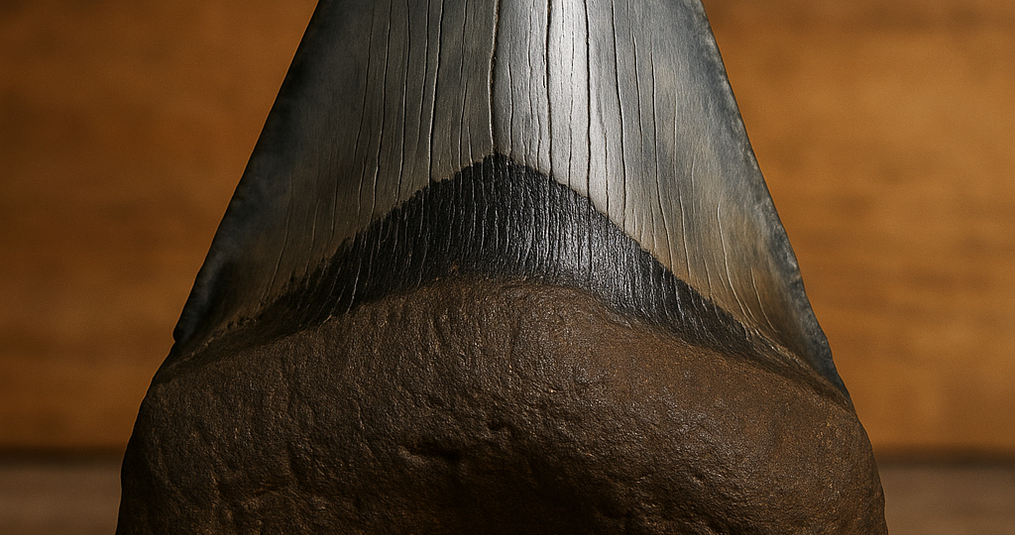
A Megalodon can really capture the imagination of many, as it is a huge shark that swam through our oceans millions of years ago, with teeth as big as your hand. The fact that we still find Megalodon teeth today and can and do collect them is simply fascinating. The question that sometimes arises is: how do you actually start collecting Megalodon teeth? Where do you find them and how do you recognise a real one? We therefore also have some tips for real beginners.
We have therefore written a comprehensive blog for you that should help you with the world of Megalodon teeth. It doesn't matter if it's your first find of your own or if you just want practical tips on how to expand your collection. You've come to the right place.
What is a Megalodon?
Before we really go further into the depths of collecting Megalodon teeth, it is important to know what a Megalodon actually is? We know that the Otodus megalodon, also known as a Carcharocles megalodon, pretty much ruled the Earth between 23 and 3.6 million years ago. We also know that the Megalodon had a length of between 15 and 20 metres. This was one of the largest predators that ever existed.
Unlike bones, which actually rarely fossilise, sharks' teeth are really incredibly well preserved. For instance, sharks lose just about thousands of teeth during their lifetimes, and those of the Megalodon are extremely suitable for fossilisation due to their size and sturdiness. This makes them relatively findable, with the caveat, of course, that you really have to know where to look.
Why collect Megalodon Teeth?
Megalodon teeth can really capture the imagination, these have really been incredibly popular among true fossil collectors, natural history enthusiasts and also really adventure seekers. The great idea of those well-known tangible remains, which you can just hold in your hands, is what makes these fossils so incredibly attractive. Whether you are attracted by their scientific significance, their visual beauty, or their value on the market, there are countless reasons why people are fascinated by collecting megalodon teeth.
- Historical value
A real Megalodon tooth is definitely not just any object, it is a real relic of an era when the Earth really looked different. By owning this fossil, you can connect with a ruthless creature that ruled our oceans for millions of years. All our teeth tell a story, this one about evolution, the ecosystem of the ancient seas and also how that shark lost and fossilised the tooth, so to speak. For an awful lot of collectors, a Megalodon tooth or a fossil of significant importance a sense of connection with the past is most important and therefore really a driving force.
- Aesthetics
Megalodon teeth are often incredibly beautiful. The nice thing is that they can vary so much in colour, think: deep black, grey-blue, beige, brown, or in the most unique case, an iridescent one with a pearly sheen. It depends entirely on the mineral content and also the type of mineral that has been in the ground with the tooth. The shape is both robust yet elegant, it is sharp, symmetrical and sometimes still has clearly visible serrations along the cutting edge. Some collectors choose their teeth purely on the visual characteristics. Here they build a collection of aesthetics, which will not be inferior to works of art.
- Educational
We know that a Megalodon tooth can provide a unique opportunity for young and also old to learn more about the history of our planet. These teeth really raise questions such as, how big was the Megalodon? What did the Megalodon eat? Why did it go extinct and also where were the teeth found? This makes the teeth so extremely suitable for in schools, museums or other locations where that creative activities are held with the children. In the family, too, they can give rise to conversations about evolution, fossilisation and also science in general.
- Investment
Besides the educational and also emotional value, Megalodon teeth also have their financial side. Fossils are found everywhere but are still incredibly scarce. The demand for fossils therefore continues to grow continuously, with this the value of quality teeth often increases along with it. Large and undamaged or unique specimens are becoming increasingly rare, making them extremely interesting for collectors and investors. This just like with art or rare coins, the rarer and more complete a fossil is, the higher its potential long-term value. Of course, you should never collect just for the sake of profit, but it is a nice idea that a beautiful tooth in your showcase is actually worth something.
- Adventure and satisfaction
For those looking for fossils, collecting Megalodon teeth represents a real source of adventure and also discovery. Searching, as well as digging or self-digging sand and also gravel is a huge experience in itself. Nothing rivals the same feeling of that one find, a tooth you found yourself after hours of searching. It is definitely an experience that will stay with you forever. After all, you never know what you will find and that makes every search unique.
- Connection with others
Fossil collectors worldwide form one very tight-knit community. For instance, there are so incredibly many online forums, fairs, Facebook groups and fossil markets where people share knowledge, display finds and exchange experiences. So collecting Megalodon teeth is also simply even a social hobby. Beginners can easily connect with experienced collectors, and this often leads to valuable insights and friendships.
- Unique character
In conclusion, no two Megalodon teeth are exactly the same. All teeth each have their own colour, wear, shape and history. This makes collecting not only fascinating, but also very personal. You can build your own collection entirely to your liking, whether you are looking for the biggest, the most colourful, or specimens from specific deposits. Each new tooth in your collection will add another piece of uniqueness.
Where can you find Megalodon teeth?
Megalodon teeth are really found all over the world, yet there are certain areas where that Megalodon teeth and also other fossils are really extra rich. Most of these teeth come from ancient sea beds that have since dried up or where that rivers cut through. We have a number of known find spots:
- United States - Florida & South Carolina
An incredible number of Megalodon teeth are found in the rivers and ancient sea beds of these states. Particularly around the city of Venice in Florida (known as the place to find shark teeth, so here you can just even find teeth on the beach.
- Morocco
In North Africa, especially in phosphate mines, beautiful teeth are found. Often, though, these have been restored.
- Netherlands and Belgium
Although you don't find them as often here, fossil shark teeth, including those of Megalodon, are found in gravel pits, dredging operations and sometimes on the Maasvlakte.
- Deep-sea diving or river diving
Experienced collectors dive in rivers like the Cooper River in South Carolina. However, this is not without risks and certainly not recommended for beginners without experience and proper guidance.
How do you start collecting?
So you really don't have to go digging or diving by yourself to collect Megalodon teeth. There are an awful lot of different ways to get started:
- Buying from fossil shops
An awful lot of different collectors have been known to buy their first Megalodon tooth from Megalodontand.nl. This is not surprising, of course, as we only do business with reliable suppliers, divers and also miners. This is also the reason why we dare to issue a certificate of authenticity ourselves. This is because we stand 100% behind our suppliers. They have really proven themselves over years of work and collecting.
- Fairs and Fossil Markets
Here, fossils can often be seen and compared with your own eyes. You can then also ask questions directly to the sellers, making it incredibly valuable for beginners.
- Self-search
Still want to find teeth yourself? Then check out accessible areas such as beaches where fossils have already been found, so start small. Do good research beforehand, as you are not allowed to collect fossils just anywhere. In the Netherlands, for example, the Archaeology Act applies, which sets rules for collecting.
Tips for recognising real Megalodon teeth
For real beginners, it is incredibly difficult to distinguish real from fake teeth. We have therefore listed some characteristics of real teeth for you:
- Size and shape
Megalodon teeth are actually always triangular with a sharp point and also jagged edges. These teeth are often between 5 and as much as 18 cm long.
- Colour and texture
This depends entirely on the type of mineral and also the soil in which your tooth fossilised. We often see colours ranging from black to grey-blue, to even smoky. We know that the texture and especially the texture of the enamel feels smooth, however, this should not feel like that plastic would feel.
- Root and crown
A perfect tooth consists of a crown and a root, both parts must be present to contribute to a high value. For instance, a missing root can really reduce the value significantly.
- Recovery tracks
In some cases, teeth are even restored. So you have to look carefully for any lines or also colour differences that indicate some more bonded pieces. So this will not just be bad, it will affect the value.
What is the value of a Megalodon tooth?
We know that the value of a Megalodon tooth can vary considerably and also certainly depends on several factors. Should you be considering buying or selling a tooth, or if you are just curious about the value of your find. Then you really want to be able to understand the following factors:
- Size: The larger that the tooth is, the rarer and, more importantly, more valuable it will be. For instance, teeth that are 5 cm in size are often quite common, however, when you go towards 10 cm, it definitely becomes a lot rarer. If we are talking about teeth of 15 cm or more, then we are really talking about top pieces among collectors and this can raise the price considerably.
- Completeness: Teeth that are truly fully intact, this without broken tips, damaged roots or chipped serrations are incredibly valuable. This compares with specimens that clearly have a lot of damage. Thus, small chips can have a considerable impact on the price, this especially if we are talking about the larger specimens.
- Provenance: The location of where the teeth are found also plays a very big role. The teeth that come from the known sites such as South Carolina, parts of Florida have considerably more value, this is because they are often also found in better condition and they are also super well documented.
- Uniqueness: Teeth with very special features, this such as anomalous shapes, double roots, unusual fossilisation patterns or just extreme asymmetry, may just be extra valuable. These teeth are not just rare, but also extremely popular with truly specialised collectors. You can find a small, damaged tooth from around €20, ideal for novice collectors or as an entry-level item. As the tooth gets larger, more complete and unique, the price rises exponentially. An impressive specimen measuring over 15 cm in excellent condition can easily be worth thousands of euros, especially if it is a tooth with rare colour or exceptionally neat fossilisation.
Keep in mind that the various restored teeth are worth much less than the complete real ones, even if they look perfect. So you really want to always ask about any restorations when buying.
Conclusion
We at Megalodontand.nl understand better than anyone else that collecting teeth is not just a hobby, but through it you can really connect yourself with an era that existed long before mankind. Every tooth tells a story. Maybe it is the tooth of a shark that swam in what is now a riverbed 15 million years ago. Maybe there is a fossil waiting for you somewhere on a beach, in a gravel pit or at a fossil market.